
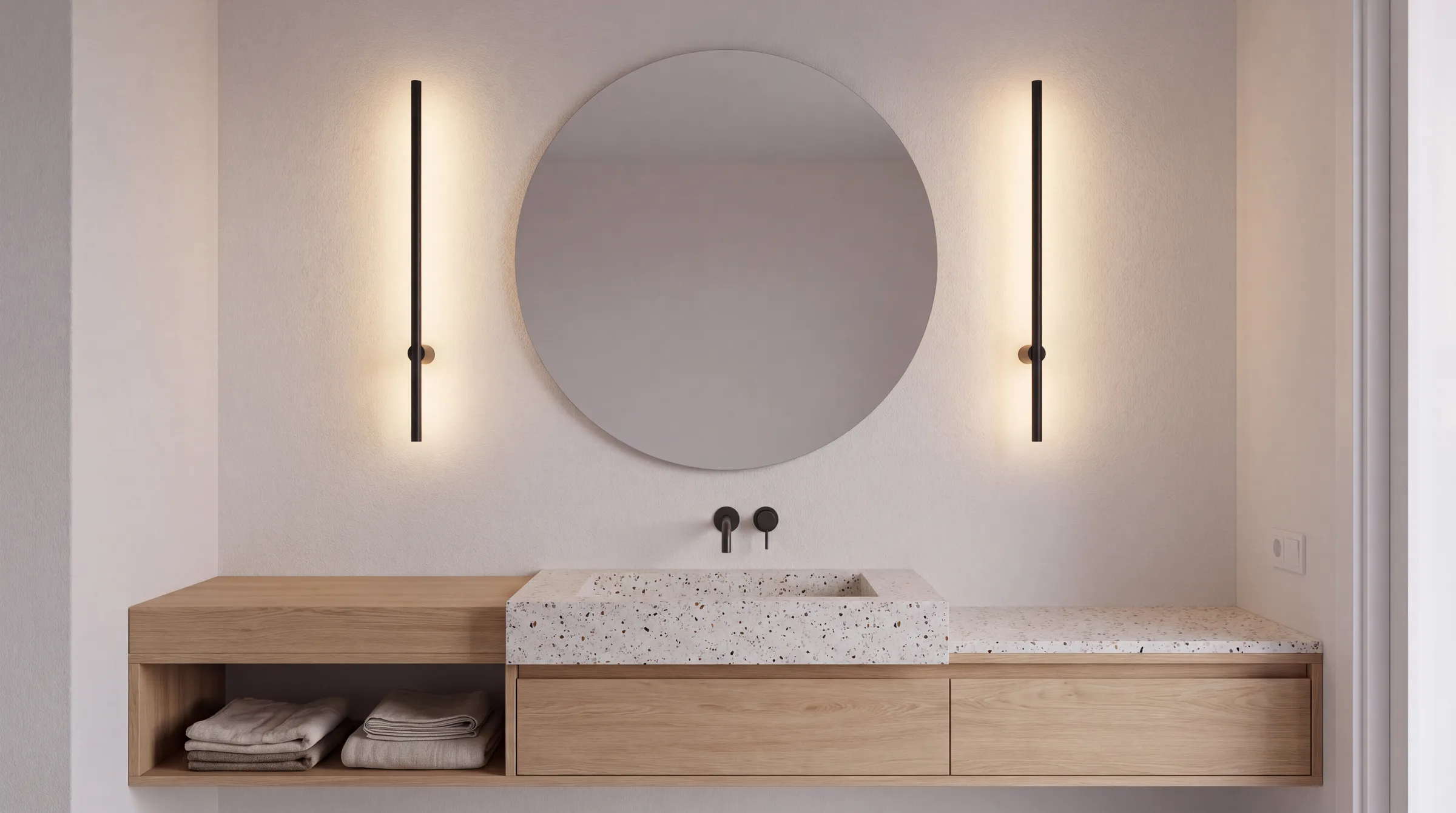
The key to the bathroom is the mirror: fit the wall lights on both sides of the mirror, at eye level (1.60–1.70 m), and your face will be lit from the front, without shadows. A single point above the mirror casts shadows under the eyes and chin. For putting on make-up or shaving, a neutral 4000 K light works better; for atmosphere, 3000 K. Here is everything, area by area.
Mirror lighting: the one you cannot get wrong
Of all the lights in the bathroom, the mirror light is the one that leaves no room for error: it is the one you use for shaving, putting on make-up or taking a close look. The rule is to light the face from the front and evenly, and you achieve that with two light points on either side of the mirror, at eye level (1.60–1.70 m from the floor). The rest of the bathroom lighting — the ceiling, the shower — is complementary; this one comes first.
The reason is that skin is lit better from the sides than from above: front-facing, evenly spread light creates no shadows and shows the face as it is, without the artificial dark circles caused by an overhead light. It is the same principle as dressing-room mirrors surrounded by bulbs: light all the way round so that no shadow is left.
It is worth thinking about the whole room: the mirror light takes care of the face, but a pleasant bathroom needs that main light to sit alongside soft general lighting, with nothing dazzling. The aim is enveloping light without harsh contrasts, where the mirror stands out as the brightest point, not the only one in the room.
Wall light above or beside the mirror?
The short answer is beside it. A wall light placed only above the mirror throws light from above and creates shadows under the eyes, nose and chin, exactly where you do not want them. Two vertical wall lights, one on each side, light the face from the front, without shadows.
The ‘above’ option only works if the mirror is narrow and you use an elongated fitting that covers the whole width evenly, like a light bar. As soon as the mirror is wide, the sides win every time. Practical measurements for side wall lights:
- Height: the centre of the wall light at eye level, 1.60–1.70 m.
- Spacing: about 60–70 cm between them if the mirror is wide, or right at the edges if it is narrow.
- Type: vertical or elongated wall lights, which spread the light along the whole face.
The models designed for this area are in the collection of bathroom wall lights for the mirror.
Colour temperature for the bathroom: make-up and shaving
For precision tasks at the mirror, a neutral 4000 K light reproduces the real colours of the skin more faithfully and makes it easier to put on make-up or shave without surprises when you step out into daylight. If you would rather give the bathroom a more relaxed, spa-like feel, go down to 3000 K, which is warmer.
Many bathrooms use both temperatures: neutral at the mirror, to see clearly, and warm everywhere else, for atmosphere. Also look for a CRI of 90 or more: at the mirror, colour accuracy matters as much as the amount of light. To choose wisely between warm and neutral, see the guide warm or cool light?.
Typical mistakes: shadows, glare and rust
The most common mistakes in a bathroom come down to three:
- Shadows on the face: lighting only from the ceiling or only above the mirror.
- Glare: bare, powerful light sources without a diffuser, which are uncomfortable when they reflect in the mirror and on the tiles.
- Rust: fitting a light without the right protection or materials in the wet zone. Constant humidity damages finishes that are not made for it.
To avoid the last one, choose wall lights made from materials that resist humidity and corrosion, designed for the bathroom: they stand up to steam and splashes without losing their looks over the years. With the right height — which we detail in the guide to wall light height —, the right IP rating and the wall lights on either side of the mirror, the bathroom becomes more comfortable, safer and longer-lasting.
With those three fronts covered — position on either side of the mirror, the right IP protection and humidity-resistant materials — the bathroom is ready to last for years without surprises.